Published June 24, 2026
Yunnan Coffee vs Costa Rica Coffee: A Complete Comparison
Yunnan and Costa Rica are two of the most exciting origins for honey-processed coffee in the world. Costa Rica practically invented the honey process — a method that leaves a controlled amount of mucilage on the bean during drying to create sweet, fruity flavors. Yunnan, meanwhile, has adopted honey processing at scale and turned it into a signature style that's winning over specialty buyers globally.
But that is where the easy parallels end. Costa Rica is a mature specialty origin with decades of microlot culture, strict altitude grading, and a reputation for traceability. Yunnan is a rising powerhouse — larger, cheaper, and more experimental, but still finding its identity on the world stage.
In this guide, we compare Yunnan and Costa Rica coffee across growing conditions, varieties, processing expertise, flavor, sustainability, and value. If you love honey-processed coffee, this is the comparison you need.
At a Glance: Yunnan vs Costa Rica
| Factor | Yunnan | Costa Rica |
|---|---|---|
| Altitude | 1,000–1,900 m | 800–1,800 m |
| Primary Varieties | Catimor, Caturra, Typica, Bourbon | Caturra, Catuai, Villa Sarchi, Geisha |
| Processing Specialty | Honey, natural, super-anaerobic | Honey (yellow, red, black), washed |
| Body | Medium to full, creamy | Medium, silky |
| Acidity | Mild to moderate, apple-like | Bright to moderate, citrus-like |
| Annual Production | ~150,000–200,000 tonnes | ~15,000 tonnes |
| Export Focus | Specialty (growing), mostly domestic | 90%+ specialty export |
| Average Price (Roasted 250g) | $8–18 | $14–28 |
Terroir & Growing Regions
Yunnan's coffee lands are spread across Baoshan, Pu'er, Lincang, and Dehong — a region roughly the size of England. The subtropical highland climate gives distinct wet/dry seasons, with annual rainfall around 1,000–1,500mm. Soils are rich in organic matter from centuries of forest growth. The key advantage: latitude. At 21–25°N, Yunnan is near the northern limit for Arabica cultivation, which slows cherry maturation and concentrates flavor over a longer growing cycle.
Costa Rica packs an extraordinary density of coffee into a small country. Its eight coffee-growing regions — Tarrazú, West Valley, Central Valley, Brunca, Orosi, Turrialba, Guanacaste, and Tres Ríos — each have distinct microclimates. Tarrazú is the crown jewel: high altitude (1,200–1,800m), volcanic soils, and consistent rainfall create ideal conditions. The entire country covers roughly 51,000 sq km — smaller than Yunnan's coffee belt alone.
The critical difference: Costa Rica's volcanic soils give a mineral complexity that Yunnan's organic-rich soils don't quite match. However, Yunnan's larger area allows for more diverse flavor expression across sub-regions.
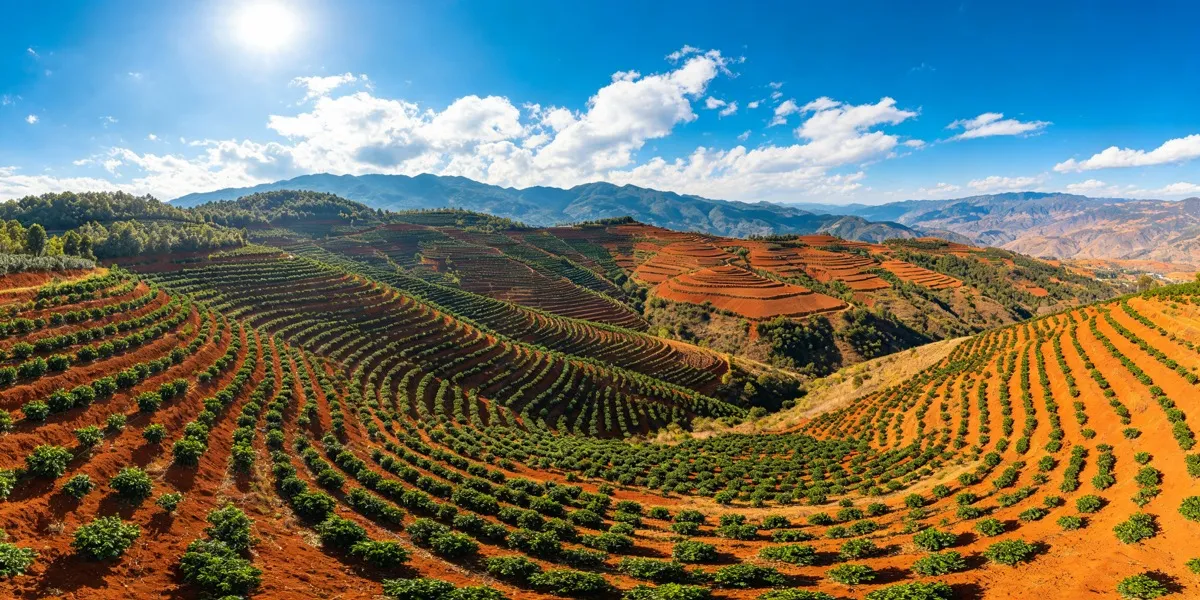
Yunnan's highland farms in Pu'er and Baoshan produce most of China's specialty coffee, with growing emphasis on honey and natural processing.
Varieties: Caturra Dominance vs Catimor Dominance
Both origins rely heavily on Caturra — a Bourbon mutation prized for its excellent cup quality and moderate yield. But they diverge dramatically from there.
Yunnan is overwhelmingly Catimor (90%+). Only in recent years have farmers begun planting Caturra, Typica, Bourbon, and Geisha. This means most Yunnan coffee carries Catimor's signature: consistent, clean, and chocolatey but with a lower flavor ceiling than traditional Arabica varieties.
Costa Rica grows Caturra, Catuai, and Villa Sarchi as its workhorses, alongside Geisha (Gesha) in the most prestigious microlots. The country banned Catimor-derived varieties in the 1980s over quality concerns — a decision that forced farmers to focus on traditional Arabicas with higher cup potential. This variety advantage is a major reason Costa Rica commands premium prices.
| Variety | Origin | Flavor Notes | Yield | Specialty Rating |
|---|---|---|---|---|
| Catimor | Yunnan (90%+) | Chocolate, nut, mild | High | ⭐⭐⭐ |
| Caturra | Both (common) | Apple, honey, bright | Moderate | ⭐⭐⭐⭐ |
| Catuai | Costa Rica | Citrus, caramel, clean | High | ⭐⭐⭐⭐ |
| Villa Sarchi | Costa Rica | Floral, orange, complex | Low | ⭐⭐⭐⭐⭐ |
| Geisha | Costa Rica (rare) | Jasmine, bergamot, tea-like | Very low | ⭐⭐⭐⭐⭐+ |
| Typica/Bourbon | Yunnan (growing) | Caramel, red fruit | Low | ⭐⭐⭐⭐ |
Honey Processing: Who Does It Better?
This is the marquee matchup. Both origins are famous for honey processing, but they approach it differently.
Costa Rica classifies honey-processed coffee by the amount of mucilage left on the bean — yellow honey (least), red honey (medium), and black honey (most). Yellow produces the cleanest cup with gentle sweetness; black honey creates a bold, almost natural-like profile with heavy body and intense fruit. Costa Rican farmers have refined these techniques over generations, and the result is exceptional consistency and clarity.
Yunnan takes a less rigid but more adventurous approach. Many smaller farms experiment with different mucilage levels without formal classification. The result can range from excellent to inconsistent. However, Yunnan's willingness to push boundaries means you can find honey-processed coffees with flavor notes — tropical fruit, wine, fermented stone fruit — that Costa Rican honey processing rarely produces.
Flavor Profile Showdown
Yunnan
Washed: Milk chocolate, green apple, almond, jasmine tea — clean and approachable
Honey: Brown sugar, peach, vanilla — sweet and round
Natural: Dark berry, cocoa, fermented fruit — bold and fruity
Super-anaerobic: Winey, tropical fruit, whiskey — experimental and intense
Costa Rica
Washed: Orange, honey, milk chocolate — bright and balanced
Yellow honey: Pear, honeydew, almond — delicate and sweet
Red honey: Stone fruit, caramel, tea-like — complex and layered
Black honey: Dark fruit, molasses, full body — bold and rich
If you put a Yunnan honey and a Costa Rica yellow honey side by side, you would taste the difference immediately. The Costa Rica has a clarity and precision that comes from decades of practice. The Yunnan has a wildness — a sense that the farmer was trying something new. Neither is objectively better; they are different philosophies in a cup.
Sustainability & Traceability
Costa Rica is a model for sustainable coffee. The country mandates that all coffee farms register with ICAFE (the national coffee institute), which tracks production down to the individual farm level. Most Costa Rican coffee is sold by farm or by cooperative, with clear traceability. The country also has strong environmental protections — many farms are Bird Friendly or Rainforest Alliance certified.
Yunnan is improving but not yet at Costa Rica's level. Larger estates have good traceability, but smaller farms often sell through middlemen who blend beans from multiple sources. Environmental practices vary widely. Some farms use excessive chemical inputs; others (particularly the newer specialty farms) are organic by default because they cannot afford pesticides. The government's land consolidation programs are helping, but systematic traceability is still a work in progress.
Value & Pricing
| Factor | Yunnan | Costa Rica |
|---|---|---|
| Green Bean (entry) | $5–8/kg | $7–12/kg |
| Green Bean (premium) | $12–20/kg | $15–40/kg (Geisha microlots) |
| Roasted (250g bag) | $8–18 | $14–28 |
| Best Value Honey | $10–14/bag — excellent value | $16–22/bag — premium but worth it |
| Availability | Growing but still niche | Widespread in specialty shops |
The value gap is real. For the price of one bag of Costa Rican red honey ($18–22), you can buy two bags of Yunnan honey and an anaerobic-processed Yunnan to compare. If you are a home brewer looking to explore honey processing on a budget, Yunnan is the smarter play. If you want the definitive expression of what honey-processed coffee can be, Costa Rica is worth the premium.
Brewing Recommendations
| Brew Method | Best for Yunnan | Best for Costa Rica |
|---|---|---|
| Pour-over (V60) | ⭐⭐⭐⭐ — Clean, approachable cups | ⭐⭐⭐⭐⭐ — Where honey clarity shines |
| Espresso | ⭐⭐⭐⭐⭐ — Chocolatey, creamy shot | ⭐⭐⭐⭐ — Good but brighter acidity |
| French Press | ⭐⭐⭐⭐ — Full body, great mouthfeel | ⭐⭐⭐⭐ — Silky, balanced |
| Cold Brew | ⭐⭐⭐⭐⭐ — Smooth, sweet, zero bitterness | ⭐⭐⭐ — Wastes honey complexity |
| Aeropress | ⭐⭐⭐⭐ — Clean and versatile | ⭐⭐⭐⭐ — Bright and balanced |
Which Should You Choose?
Choose Yunnan if:
- You are on a budget but still want quality honey-processed coffee
- You enjoy adventurous flavors (super-anaerobic, natural, experimental processing)
- You want multiple bags to compare without spending $50+
- You brew espresso or cold brew where Yunnan's body shines
- You want to support an emerging origin
Choose Costa Rica if:
- You want the definitive honey-processed coffee experience
- You value traceability and sustainable farming certifications
- You are a pour-over enthusiast who prizes clarity and precision
- You want to explore Geisha or Villa Sarchi microlots
- Budget is not your primary concern
Best of both worlds: Buy a bag of Costa Rican yellow honey for weekend pour-overs when you have time to appreciate the nuance. Keep a bag of Yunnan honey for daily espresso or cold brew. They complement each other perfectly.
Final Verdict
Yunnan vs Costa Rica: the verdict.
Costa Rica is the more polished origin — better varieties, stricter grading, more consistent quality, and world-leading honey-processing expertise. It is the wine of Burgundy: refined, terroir-driven, and expensive for good reason.
Yunnan is Beaujolais — lighter on the palate, more playful, and vastly more affordable. It does not offer the same peak quality, but it offers something Costa Rica rarely can: surprise.
If you care about the very best honey-processed coffee: choose Costa Rica. If you care about value, exploration, and supporting a rising origin: choose Yunnan. Most specialty drinkers should have both in their rotation.
Frequently Asked Questions
Is Costa Rican coffee better than Yunnan?
In terms of peak cup quality and processing consistency, Costa Rica has the edge — its Caturra/Catuai varieties, strict ICAFE grading, and generations of honey-processing experience produce more consistently excellent coffee. However, Yunnan offers better value and more adventurous processing options.
Which has better honey-processed coffee — Yunnan or Costa Rica?
Costa Rica is the gold standard for honey processing. Its yellow/red/black classification system and decades of refinement produce exceptional clarity and sweetness. Yunnan's honey processing is good and getting better, but it has not yet reached Costa Rica's level of consistency. That said, Yunnan's best honey-processed lots can rival mid-tier Costa Rica at half the price.
Which origin is more affordable?
Yunnan is significantly more affordable. A bag of roasted Yunnan honey costs $10–14 versus $14–28 for Costa Rican honey. Green beans tell the same story: Yunnan starts at $5/kg vs Costa Rica at $7/kg. Premium Yunnan (anaerobic, single-farm) maxes out around $20/kg, while Costa Rican Geisha lots can hit $40–60/kg.
Which origin is better for espresso?
Both work well, but for different reasons. Yunnan's chocolatey body and mild acidity create a classic espresso profile that shines in milk drinks. Costa Rica's brighter acidity works best in straight shots where its honey sweetness can be appreciated. For milk-based drinks: Yunnan. For straight shots: a toss-up depending on your preference.
Do Yunnan and Costa Rica use the same coffee varieties?
Partially. Both grow Caturra, but Yunnan is dominated by Catimor (which Costa Rica banned for quality reasons), while Costa Rica also grows Catuai, Villa Sarchi, and Geisha. The variety gap is one of the main reasons for the price and quality differences between the two origins.
Want to explore more comparisons? Check out Yunnan vs Kenya Coffee, Yunnan vs Colombian Coffee, Yunnan vs Ethiopian & Brazilian Coffee, and Yunnan vs Vietnam Coffee.
Looking to buy? Our Yunnan Coffee Buying Guide (Chinese) has recommendations for roasters and specific beans to try.